



Description
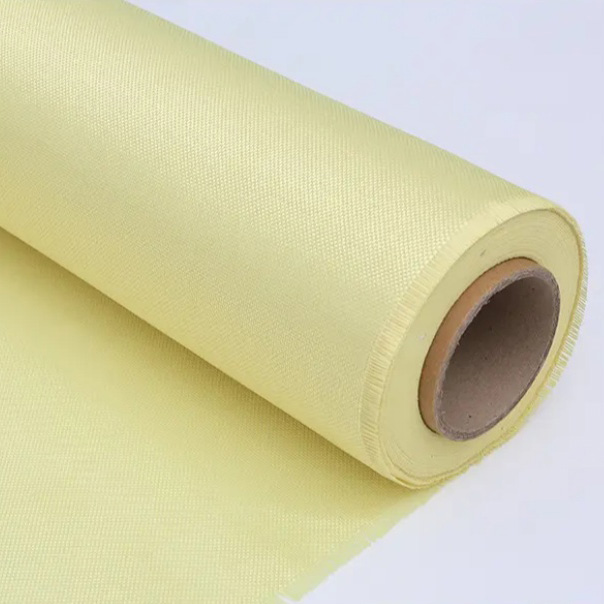
The AWP200-1000 is a plain weave 1000D Kevlar fabric under the QINI brand, designed for impact resistance, thermal stability, and mechanical strength applications. This woven Kevlar material features a standard width of 1000mm, a surface weight of 200g/m², and a standard roll length of 100m per roll. With a uniform plain weave structure and a material density of approximately 1.44g/cm³, the fabric delivers consistent protective performance while maintaining a lightweight profile. Compared to carbon fiber fabrics, this Kevlar fabric has higher flexibility and impact absorption capacity, applicable across multiple industrial sectors. For commercial procurement needs, customization options for surface weight (100g/m²–300g/m²) and fiber denier (400D–3000D) are available to match specific application requirements.
Code | Warp | Weft | Density(g/m²) | Thickness | ||
|---|---|---|---|---|---|---|
Fiber | Weight(g/m²) | Fiber | Weight(g/m²) | |||
AWP100-400D | 400D | 50-54 | 400D | 50-54 | 100-108 | 0.1 |
AWP100-600D | 600D | 50 | 600D | 50 | 100 | 0.1 |
AWP145-800D | 800D | 72-73 | 800D | 72-73 | 145 | 0.14 |
AWP160-800D | 800D | 80 | 800D | 80 | 160 | 0.16 |
AWP200-1000D | 1000D | 100 | 1000D | 100 | 200 | 0.2 |
AWP300-3000D | 3000D | 150 | 3000D | 150 | 300 | 0.3 |
Code | Weave Type | Density of Warp & Weft | Density g/m2 | Thickness mm | Width MM | |
|---|---|---|---|---|---|---|
Warp | Weft | |||||
AWP200 | Plain | 1000D+100g | 1000D+100g | 200 | 0.20 | 1000 |
To accommodate varied industrial application requirements, QINI provides customizable parameters for this woven Kevlar fabric series. Fiber denier options cover 400D, 600D, 800D, 1000D, and 3000D, corresponding to different protective intensity and weight requirements. Surface weight is adjustable within the range of 100g/m² to 300g/m², matching different thickness and performance specifications. Standard roll length is set at 100m per roll, with width specifications aligned to the product series. Enterprise customers may consult the sales team for volume order details and custom parameter confirmation.
Advantages
This 1000D Kevlar fabric adopts a balanced plain weave process, with consistent warp and weft fiber specifications to ensure uniform performance across the fabric surface. The plain weave structure forms a stable fabric grid, delivering consistent impact dispersion performance across the entire material. With a thickness of 0.2mm for the 200g/m² variant, the fabric maintains a low profile while retaining structural integrity. Its density of approximately 1.44g/cm³ reduces the weight of end products, lowering load for wearable applications without reducing protective performance. Unlike carbon fiber materials that prioritize structural rigidity, this Kevlar fabric offers higher flexibility and impact energy absorption. This property supports use in applications that require both impact resistance and a certain degree of bending or fitting, such as curved protective gear and irregular component linings. The material also retains stable physical properties under elevated temperature conditions, adapting to scenarios with thermal exposure requirements. For industrial processing, the fabric can be cut, laminated, and combined with other substrate materials to form composite structures, compatible with different manufacturing processes for end products.
Application Area
 | Personal Protective EquipmentThis 1000D Kevlar fabric serves as a base material for personal protective gear including body armor and fire-resistant clothing. Its impact resistance and thermal stability deliver protective performance for end users, while its lightweight and flexible properties support extended wear periods. The fabric can also be processed into fire blankets and protective gloves for industrial operation scenarios. |
Aerospace Component & Interior ManufacturingIn the aerospace sector, this Kevlar material is used to produce high-speed rotating components such as bearings, gears, and transmission belts, leveraging its mechanical strength and high temperature stability. It also applies to aircraft interior linings, shell structures, and rubber sealing components, helping reduce overall component weight while meeting performance requirements. |  |
 | Automotive Safety & Engine ComponentsFor automotive applications, the fabric can be processed into reinforcement structures for safety components such as airbag systems. It also serves as a material for engine parts including valves, valve seats, piston rings, and camshaft gears, benefiting from its heat resistance, low friction properties, and mechanical strength. Additional use cases include transmission systems, braking systems, and electrical system components in vehicles. |
Maintenance
'Maintenance Guidelines for Woven Kevlar Fabric
 | Clean the surface of the carbon fiber Fabric. During use, dust and stains on the surface of carbon fiber Fabric should be cleaned in time, and special cleaners should be used to avoid acidic or alkaline cleaners. |
 | Prevent carbon fiber Fabric From being exposed to sunlight for a long time. Long exposure to sunlight will make the surface of carbon fiber Fabric crack and fade, affecting the beauty and service life. |
 | When storing carbon fiber Fabric Attention should be paid to avoid humidity, high temperature and other environments. When storing carbon fiber Fabric, avoid humidity, high temperature and other environments, and keep dry and ventilated. |
FAQ
Yes. With a surface weight of 200g/m² and flexible fabric structure, this material reduces fatigue during extended wear. Many law enforcement personnel use protective vests made with this fabric for 8 or more hours per day.
Yes. This Kevlar fabric is often laminated with materials such as carbon fiber to produce hybrid composite structures. For example, in automotive door panel production, Kevlar layers provide impact resistance while carbon fiber layers contribute structural rigidity.
The QINI Kevlar fabric series includes 400D for lightweight gloves, 600D for bag manufacturing, 800D for lightweight protective gear, 1000D for standard protective armor, and 3000D for heavy-duty industrial protection. Users may select the appropriate denier based on their specific application requirements.


